JLR to 'pause' shipments to US after Trump tariffs

WASHINGTON, DC - APRIL 02: U.S. President Donald Trump speaks during a “Make America Wealthy Again” trade announcement event in the Rose Garden at the White House on April 2, 2025 in Washington, DC. Touting the event as “Liberation Day”, Trump is expected to announce additional tariffs targeting goods imported to the U.S. (Photo by Chip Somodevilla/Getty Images)

Car giant JLR has announced a pause in shipments to the United States to tackle "address the new trading terms" imposed by Donald Trump's tariffs.

Thursday saw the imposition of a 25% tax on all foreign-made vehicles entering the US, followed by the introduction of a 10% "baseline" tariff on global imports on Saturday morning.

JLR, formerly Jaguar Land Rover, is one of many firms worldwide contending with the repercussions of the new trade rules and the resulting market instability.

In a statement issued on Saturday, a JLR spokesperson confirmed: "The USA is an important market for JLR's luxury brands.

They added, "As we work to address the new trading terms with our business partners, we are taking some short-term actions including a shipment pause in April, as we develop our mid- to longer-term plans."

Global trade has been significantly impacted following President Trump's declaration of the tariffs at the White House this past Wednesday.

The fallout was significant, with the FTSE 100 enduring its worst trading session since the pandemic began on Friday, and comparable downturns affected Wall Street as well.

The FTSE 100 saw all but one stock fall, with Rolls-Royce, the banking sector, and mining companies witnessing substantial losses.

Prime Minister Sir Keir Starmer has pledged to “do everything necessary” to protect the UK’s national interest after the tariffs were imposed, saying ministers are “ready to use industrial policy” to support businesses.

Writing in the Sunday Telegraph, he said “the immediate priority is to keep calm and fight for the best deal”.

He said that in the coming days “we will turbocharge plans that will improve our domestic competitiveness”, and added: “We stand ready to use industrial policy to help shelter British business from the storm.”

London's leading stock market index, the FTSE 100, dropped 419.75 points, or 4.95%, to close at 8,054.98 on Friday, marking the largest single-day fall since March 2020 when the index lost more than 600 points in one day. The Dow Jones also took a hit, falling 5.5% on Friday as China matched Mr Trump's tariff rate.

Beijing announced it would retaliate with its own 34% tariff on imports of all US products from April 10.

Ministers are still striving to secure a deal with the US, hoping that it could provide some exemption from the tariffs.

Rachel Reeves stated on Friday that the Government is "determined to get the best deal we can" with Washington.


North East automotive sector could see thousands of jobs created once current 'turbulence' is overcome

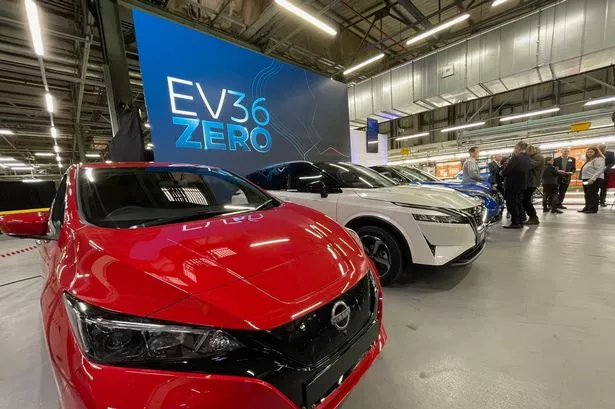
Building of new electric vehicle models and the batteries to power them has the potential to create up to 3,500 jobs in the North East, a key car manufacturing group has indicated. The North East Automotive Alliance (NEAA) says the region's industry has a combined turnover of £10.3bn and employs about 27,000 people but could create significant growth once current turbulence in the sector has been navigated. A significant part of that activity is underpinned by Nissan's Sunderland operation, which earlier this week confirmed it was cutting back production at the plant amid global cost cutting. Responding to the news, Paul Butler, who is CEO of the body which represents supply chain companies, said it was reflective of the significant flux in the global automotive sector but also demonstrative of the agility of the North East automotive sector in managing the challenging conditions. Mr Butler referenced well-publicised semiconductor shortages on the back of Covid, the emergence of new competitors such as BYD and Tesla and falling sales in traditional car markets in Western Europe and North and South America between 2019 and 2024, due to economic challenges, and concerns about range and charging technologies for electric vehicles. The UK Government's Zero Emission Vehicle Mandate - which requires 100% of all new car sales to be EV by 2035 - has also prompted concern from manufacturers with Nissan itself among those warning the measures threatened jobs. A consultation on the measures was launched by Government and the NEAA says the sector is now eagerly awaiting its results. Mr Butler also highlighted the Vehicle Excise Duty 'Expensive Car Supplement' on battery electric vehicles which will mean models costing more than £40,000 will incur a £3,110 tax bill over the first six years of ownership - a move the Society of Motor Manufacturers and Traders has said undermines ambitions to transition to electric motoring. Mr Butler said: "Given all these headwinds it is not surprising that we are in a very turbulent period, whereby companies must act to market conditions. This is a strategic decision that has been taken to improve efficiency, with no changes to the current number of employees, nor planned investment. The Nissan Sunderland plant continues to be at the forefront of vehicle electrification, with new all-electric Leaf and the third-generation e-Power Qashqai models to be built in Sunderland." Despite the challenges facing Nissan and the wider sector, there has been continued investment in the region's automotive sector in recent months, including the announcement by Nissan-owned transmission supplier Jatco that it will set up a £48.7m factory near the Wearside plant. Jatco boss Tomoyoshi Sato told us he hopes the facility will grow to serve more manufacturers in Europe such as Volkswagen and BMW. Last week the £1m National Battery Training and Skills Academy was launched by New College Durham and Newcastle University. The training facility at the college's Framwellgate Moor Campus will initially support the second Sunderland gigafactory of battery maker AESC, which opened the country's first such plant in the same location 13 years ago. The UK's new car market got off to a shaky start this year, with a -2.5% decline to 139,345 units in January. Meanwhile, both hybrid electric vehicles and plug-in hybrids saw growth and their market shares rising to 13.25 and 9% respectively, while battery electric vehicle registrations were up 41.6% year-on-year to take 21.3% market share.

Read more
Pearson Engineering works on robot mine sweeper being trialled by British Army

North East defence specialist Pearson Engineering has helped to develop a robot mine sweeper which is now being trialled by the British Army to clear explosives on the front lines. The Newcastle company, based in the famous Armstrong Works, has worked with the Defence Science and Technology Laboratory (Dstl) to create Weevil, a device which is hoped will replace current mine-clearing methods that included Trojan armoured vehicles, which require a three-person team to operate in hazardous areas. The robot mine sweeper is said to be able to clear minefields quicker and safer than present capabilities, reducing risk to soldiers on the front line and it can be operated via remote control by just one person from several miles away. The prototype – which is fitted with a mine plough to clear a safe path – has been successfully tested on a surrogate minefield in Newcastle, and the technology is now being passed to the British Army for further development and more trials. Ian Bell, CEO at Pearson Engineering, said: “We are proud to contribute to such game-changing capability. It brings together decades of development by Pearson Engineering, delivering the very best of minefield breaching technology proven around the world, and contemporary developments in teleoperation. “Work with UK MOD is an incredibly important part of our business, ensuring our troops get the latest in combat engineering capability and that we can effectively defend our nation and allies.” Luke Pollard, minister for the armed forces, said: “It won’t be a moment too soon when we no longer have to send our people directly into harm’s way to clear minefields. “This kit could tackle the deadly threat of mines in the most challenging environments, while being remotely operated by our soldiers several miles away. “It demonstrates British innovation, by British organisations, to protect British troops.” The robot was developed by the Defence Science and Technology Laboratory (DSTL) and Newcastle-based firm Pearson Engineering. The Ministry of Defence said there are no current plans to provide it to Ukraine. DSTL military adviser Major Andrew Maggs said: “Weevil is the perfect combination of tried and tested technology and modern advancements.

Read more
Versarien completes sale of South Korean factory for more than £600k

Gloucestershire-based engineering firm Versarien has completed the sale of its South Korean factory and equipment for more than £600,000. The agreement with MCK Tech was announced last March as part of a strategy to monetise intellectual property (IP) through licensing. The transaction was meant to complete last July, but was delayed after MCK Tech asked for an extension to the deadline. Longhope-based Versarien has now received the final payment of £92,000, plus accrued interest, it announced on Monday (March 3). In total, Versarien has received £611,000 after a £6,000 warranty deduction from MCK Tech for its Korean plant and equipment. Under the terms of the deal, AIM-listed Versarien has granted an exclusive licence to MCK Tech for an initial period of five years, to use five patents owned by the firm in their business in Korea. MCK Tech will pay Versarien an amount equal to 4.5% of the total sales revenue earned from products manufactured using the IP. If the sales revenue derived from the IP is less than £250,000 over the first two years, the licence will terminate and MCK Tech will pay Versarien £40,000 for use of the IP. In June, Versarien said it was “optimistic” about the future after reporting a narrowing of losses. In a set of unaudited interim results, the firm reported pre-tax losses of £1.77m - down from £3.4m the year previously - for the six months ended March 31, 2024. In December, the company revealed its Spanish subsidiary has secured a €804,000 grant. Versarien said at the time that the money would be used by Gnanomat to finance a two-year project relating to a high-tech energy storage devices. Versarien also signed an agreement with infrastructure group Balfour Beatty last year to develop a range of low-carbon, graphene‐infused, 3D‐printable mortars for civil construction.

Read more
Cheshire's Packaging One doubles workforce having secured seven figure funding deal

Jobs have been created by family-run Packaging One following a seven-figure funding deal from NatWest and Royal Bank of Scotland. The provider of protective wrappings and boxes, among other products, intends to double its workforce to 80 people following the funding injection. Expansion into the firm's 44,000 sqft premises in Middlewich has given Packaging One increased manufacturing capabilities by about 70% amid a recently secured contract with an unnamed customer described as a 'global tech giant' for its patented MediaWrap product which is used for protecting trade-in and recycled mobile devices. Packaging One was set up in 2008 and is run by husband-and-wife team Ian and Emma Chesworth, who have more than 30 years' experience in the industry. The business' operations span the UK, Europe and USA Mr Chesworth, director of Packaging One, said: “The expansion is a huge step in our growth and development. Not only is it good for our business but we are proud to be able to contribute to our community by creating new jobs and employing local people.” Fellow director Mrs Chesworth added: "We have been working with the NatWest team for almost two decades. Over that time, they have partnered with us to support our business and helped us reach key milestones around our growth and expansion." Claire Morley, senior relationship manager at NatWest, said: “We are thrilled to support Ian, Emma and the Packaging One family as they begin a new chapter in their business development. As the UK’s biggest bank for small businesses, we work collaboratively with customers to understand their needs and help them find solutions to support their businesses as they grow.

Read more
Ibstock slashes dividends as profit tumbles amid 'subdued market conditions'

Ibstock, the London-listed brickmaker, has cut its annual dividend payout following a drop in profit and revenue due to "subdued market conditions." The company reported a nearly one-third decrease in pre-tax profit to £21m for the year ending 31 December. Ibstock attributed this figure to a "lower trading performance" and the impact of a one-off £12m charge, as reported by City AM. Revenue fell by 10% to £366m as sales slowed. The group cited a "subdued" market environment for its performance and reduced total dividends by almost half, to 4p per share. Earnings per share also declined year-on-year by 30%, to 3.8p. Despite these challenges, Ibstock noted a gradual improvement in sales during the second half of 2024 and maintained a positive outlook for 2025. "We expect an improvement in market volumes in 2025, with momentum building through the year," said Chief Executive Joe Hudson. "Ibstock is well-positioned for a market recovery, and the fundamental drivers of demand in our markets remain firmly in place." He added: "We see a significant opportunity for a new era in housebuilding in the UK and with the investments we have made and our market leadership positions, the group remains well placed to support and benefit from this over the medium term." "Shares have fallen around 14% so far this year, and the firm will also have to contend with a 21% year-on-year increase in its debt pile, which currently stands at £122m." Hudson described the 2024 performance as "resilient."

Read more
Spirax Group reports fall in full-year profits amid restructure

Cheltenham-headquartered engineering firm Spirax Group has reported a fall in profits for the financial year. The FTSE-100 company posted a 1% fall in reported revenue to £1.6bn for the 12 months to December 31, 2024. Adjusted profit before tax fell to £288.2m from £309.2m the year previously. The company said global industrial production growth for the full year was lower than had been forecast and second half recovery did not materialise with industrial production falling in key markets such as the US, Germany, France, Italy and the UK, representing around 50% of group sales. However, Sprirax added that all three of its business divisions delivered organic sales growth during the year with adjusted operating profit margins in line with expectations. According to the group, its restructuring strategy will realise annual savings of around £35m to fund investment in future organic growth. The cash costs to deliver the programme will be mostly incurred in 2025, Spirax said, and are expected to be around £35m, with an additional non-cash cost of £5m. The board declared a final dividend of 117.5p per ordinary share - up from 114p in 2023 - bringing the total dividend for the year to 165p. “The global macroeconomic environment remains highly uncertain,” the company said in a statement on Tuesday (March 11). “We remain cautious on industrial production in 2025 and have adopted more conservative assumptions in our planning. “We expect trading conditions in China to remain challenging as customers continue to reduce investments in the expansion of manufacturing capacity.” Looking to 2025, Spirax said it expected organic growth in group revenues consistent with that achieved in 2024 and “modestly higher” growth in the second half. It added that corporate costs for the year would be around £40m, reflecting higher levels of investment in growth. Nimesh Patel, group chief executive, said: "All three of our businesses delivered organic sales growth with margins in line with our expectations, despite weaker than expected industrial production in the second half. I am particularly pleased with progress in electric thermal solutions, where improvements to manufacturing throughput supported higher sales and improved margin." Mr Patel said the company was “well underway” with actions to simplify the organisation and better leverage resources to support future growth. He added: "Mindful of the outlook for industrial production, I remain confident in the execution of our strategy and in the strength of our business model.”

Read more
Tekmar Group set for 'growth like never before' after posting strong earnings boost

Bosses at offshore specialist Tekmar say its markets are aligned “for growth like never before” after seeing its earnings rise to the highest level in five years. Based in Newton Aycliffe, Tekmar Group offers technology, services and products to customers around the world, with offices, manufacturing facilities, strategic supply partnerships and representation in 18 locations across Europe, Africa, the Middle East, Asia Pacific and North America. Last December, newly appointed CEO Richard Turner announced a three-year plan to transform Tekmar and realise its potential, after seeing headwinds which have impacted offshore renewables and the conventional energy markets subsiding. Now the firm has issued full year result for the year ended September 2024, highlighting a year of stabilisation. Revenues were £32.8m, down on the previous year’s £35.6m, but adjusted Ebitda (earnings before interest, taxes, depreciation, and amortisation) was £1.7m, up from £600,000. Its operating loss was reduced from £7.9m to £3.8m in the year, a figure it said reflected the successful execution of the group’s profit improvement plan, having worked through a remaining low margin backlog. The group held £4.6m of cash at the year end, with net debt of £1.6m - a figure which excludes the SCF Capital Partners £18m finance facility which its said remains undrawn and is available to drive growth through acquisitions. During the year, the group completed the divestment of its subsidiary, Subsea Innovation Limited for £1.9m, in line with its strategy to drive profitable growth. At the end of January it said its order book stood at £16.4m. In its Stock Market notes to shareholders, Tekmar said: “The board is encouraged that the market environment is improving and supports sustained demand for Tekmar’s technology and engineering services across our markets. Moreover, we believe Tekmar’s differentiated technology positions the group to outperform this improving market. This is supported by the group’s developing sales pipeline, which the board expects will convert to orders and revenue over time.” Richard Turner, CEO, said: “Overall, these results demonstrate we now have a stronger platform from which we can execute our medium-term plan to deliver true scale and diversification. FY24 was a transitionary year for Tekmar, where we focused on the basics - providing high-quality engineering, delivering on time and maintaining consistent commercial discipline. “This supported the group reporting its highest level of adjusted EBITDA since FY20, and a material improvement in gross margin to 32%. Looking ahead, our markets are aligned for growth like never before. Our strategy looks to capitalise on our industry pedigree to drive organic growth across all revenue streams, leverage our operational gearing to enhance our returns on sales, drive value through strategic M&A and generate cash to build our reserves and fuel our growth.”

Read more
Comment: Government's actions are a useful first step but needs to do more

It was more bad news for UK auto last week when President Donald Trump announced 25 per cent tariffs on all car imports to the US. This will have a huge impact on the UK and EU auto industry which was already being squeezed by falling sales in China, stagnant demand in Europe and slow electric vehicle (EV) take-up. It's nothing short of a perfect storm for the auto industry. Cars are the UK's number one goods export to the US, at £8.3 billion in the year to the end of quarter three in 2024, out of around £58 billion in total UK exports to the US. Firms like JLR, Rolls Royce, Bentley, Aston Martin, Mini, McLaren and Morgan will be most affected. The US is the UK's largest auto export market after the EU. There will be a particular impact on the West Midlands which is the number one exporting region to the US (think JLR and Aston Martin, for example). Much of the UK auto industry is already operating well below capacity and the tariffs will be a further hit for a struggling industry. Production cuts and job losses are likely. The Institute For Public Policy Research puts 25,000 jobs at risk. Email newsletters BusinessLive is your home for business news from across the West Midlands including Birmingham, the Black Country, Solihull, Coventry and Staffordshire. Click through here to sign up for our email newsletter and also view the broad range of other bulletins we offer including weekly sector-specific updates. We will also send out 'Breaking News' emails for any stories which must be seen right away. LinkedIn For all the latest stories, views and polls, follow our BusinessLive West Midlands LinkedIn page here. That is a big underestimate as it fails to account for tipping points if plants fall below minimum viability levels and close completely, with a further impact on the supply chain. You can double or triple that number in terms of the jobs at risk. The UK is looking to do a quick trade deal with the US to avoid tariffs hitting UK auto too much. I think that is doable in a narrow sense on cars as the UK has a ten per cent tariff on US imports. Both sides could scrap auto tariffs completely and both would see it as a win. That has to be a key, immediate goal for the Government. A broader trade deal to avoid Trump's ten per cent tariffs on all UK imports will be much more tricky and will see the US wanting concessions on the digital services tax, more access for US services to the UK in areas like health, and a deal on agriculture. Think chlorinated chicken and hormone injected beef. The Government has already ruled out the latter. To help the auto industry, Prime Minister Keir Starmer this week set out changes to the UK's Zero Emission Vehicle (ZEV) mandate. This was set out as a response to Trump's 25 per cent tariff but was anyway on the cards after a huge outcry from industry last year over policy and a quick-round consultation by the Government. These changes have rather cleverly been marketed as a response to Trump's Tariffs. Nevertheless, what the Government unveiled is useful as far as it goes. The ZEV mandate policy had been inherited from the previous government and was a dog's breakfast of a policy which risked fining domestic producers for not hitting overly optimistic mandated targets, with them then likely having to buy credits from the likes of Tesla and Chinese EV producers. Fining firms making investment in the UK was always a bad idea and giving auto makers more flexibility to hit the targets makes a lot of sense. Another welcome change is allowing hybrids like the Toyota Prius or Range Rover Evoque hybrid to be sold through to 2035 (after the 20203 ban on pure petrol and diesel cars). Hybrids are a good first step for many people and help in the transition to electrification. And 2035 as a target for this is fine: the average life of a car is 15 years so that still means we can be on track to get to Net Zero by 2035. Other good news came in the form of reducing fines for non-compliance and exempting smaller producers like Aston Martin. So far, so good. But what isn't clear is whether there is any new cash for speeding up the roll out of the charging infrastructure. The Government ‘reaffirmed' £2.3billion for a range of objectives including infrastructure (in other words just reannounced money that was already committed). While the government says it is on track to reach its target of 300,000 public chargers by 2030, many of these are in London and the South East. Elsewhere, the charging network is patchy and a big deterrent to EV take up. There are also some glaring gaps in the new policy stance. Firstly, there are no incentives to boost demand for EVs. If the Government wants to speed up the market for EVs, whacking the supply side with a big stick in the form of mandates is not enough. Carrots are also needed for the demand side. Think of temporary VAT cuts to make EVs more attractive and boost demand. Sadly, the Government's self-imposed fiscal straight jacket rules this out. But, even if the UK gets a trade deal with the US, Trump's tariffs will hit world trade, growth and demand for UK exports. There will be indirect effects on UK economic growth anyway which makes hitting Rachel Reeves' eye-wateringly tight fiscal rules even more challenging. At some point, they will need to be relaxed. Last but not least, the Government's early-awaited yet delayed industrial strategy is needed sooner rather than later. It has been delayed by the Government while it is being repainted from green to battleship grey as the drive to re-arm gathers pace given Europe's inability to rely on the US for defence under Trump. Boris Johnson sadly scrapped the last industrial strategy so as to ‘build back better'. Building back badly was perhaps a more apt description of what then unfolded as growth stagnated. Putting a strategy back in place is vital to help advanced manufacturing - and automotive - on a range of issues like attracting investment into making EVs, rebuilding the supply chain (including on batteries), retraining and reskilling workers and cutting energy costs. Starmer has said the world has changed and we need to respond. It has, and while the Government's announcements this week are welcome, much more will be needed going forwards if the auto industry is to thrive in the UK.

Read more
Aston Martin announces job cuts of 170 staff as part of cost-saving measures

Luxury vehicle manufacturer Aston Martin has announced plans to slash 170 jobs as part of a cost-cutting strategy aimed at reviving its faltering share price. The proposed cuts represent five per cent of the company's global workforce and are expected to yield savings of around £25m, as reported by City AM. The announcement comes on the heels of Aston Martin, which has its HQ in Gaydon and a factory at St Athan in South Wales, reporting an expanded full-year loss of £289.1m and a three per cent dip in revenue, which totalled £1.58bn. In recent times, the brand has been wrestling with a series of supply chain and production challenges that have contributed to a mounting debt burden. Debts surged by 43 per cent to £1.16bn in 2024, while shares plummeted by approximately a third. Free cash outflows also increased by nine per cent during the same period, reaching £392m. "After a period of intense product launches, coupled with industry-wide and company challenges, our focus now shifts to operational execution and delivering financial sustainability," declared the firm's newly appointed CEO, Adrian Hallmark. He continued: "I see great potential in Aston Martin, and our goal is to transition from a high-potential business to a high-performing one, better equipped to navigate future opportunities and uncertainties. He added: " Hallmark concluded by saying: "We have all the vital ingredients for success, with the support of strategic shareholders, the capability of world-class technical partners, a revitalised brand, talented people, and the strongest product portfolio in our 112-year history." However, Aarin Chiekrie, equity analyst at Hargreaves Lansdown, has highlighted some concerns stating: "The group had to go cap in hand to investors twice last year, seeking additional funds to help keep the wheels turning." He warned that the possibility of a further cash call isn't off the table as he pointed out, "A further request for funds can't be ruled out given cash flows remain in negative territory." Chiekrie also mentioned that though reducing staff numbers is a step taken, it's only "part of the puzzle, as costs can only be cut so far."

Read more
South West bucks UK manufacturing decline as aerospace and defence firms report 'strong' start to 2025

Aerospace and defence firms in the West of England are experiencing "very strong demand" for business, bucking a wider UK decline in manufacturing, according to a new report. Manufacturers across the region have reported a strong start to the year, the survey by national manufacturing body Make UK and business advisory firm BDO found. Both output (+32%) and orders (+39%) were positive, with the forecast set to improve further in the next quarter. As a result, companies are looking to hire more staff with recruitment intentions increasing from +5% to +21% over Q2, the report said. Capital expenditure plans are also significantly ahead of the national picture at +32%, while the South West's renewable energies sector is also seeing strong demand. Nationally, Make UK is forecasting that British manufacturing will contract by -0.5% in 2025, down from a forecast of -0.2% in the last quarter, before growing by 1% in 2026. Matthew Sewell, head of manufacturing at BDO in the South West, said: “The economy in the South West relies heavily on manufacturing, in particular the strength of the aerospace, defence and renewable energy sectors . It’s encouraging to see the region have a strong start to the year, but we cannot be complacent - our manufacturers are resilient but they’re not invincible. “Manufacturers across the South West now need targeted support from government, whether that be reducing complexity, streamlining trade or boosting access to capital to enable them to focus on growth.” Make UK is now calling on the government to bring forward a long-term industrial strategy with advanced manufacturing "at its heart" to help grow the economy. Keri Anne Mruk, region director at Make UK in the South, said: “This has been a strong start to the year for manufacturers in the South West with the region bucking the national picture. "To build on this it’s now essential that Government brings forward an industrial strategy at the earliest opportunity. This will give manufacturers the confidence to plan for the future with a stable, supportive policy environment.”

Read more